Saturday, 1 March 2014

In spite of the rain

Yesterday, the weather was horrible. Apparently, on the mountain pass road to Jaca there was a multiple car crash in the morning, caused by snow and fog. We heard about it on our way from Zaragoza to Matarraña. Much further south and much lower down, it wasn't snowing, although it was cold, wet and windy all day. Matarraña, in the north-east of the province of Teruel had been in our minds for some time, and we decided to go there in spite of the nasty weather.
Even though we got cold and wet, and couldn't see the views as well as we had hoped, it was worth the effort. Any other time it wouldn't have been so pretty the almond trees, which in Huesca are only just starting to come out, were in full bloom there. Moreover, the arrangement of the trees was unusually pretty. They were alternated with the olive trees for which the region is famous.
I took a few seconds of video to record the rushing wind blowing the trees.


The first destination was the biggest town in the area, Calaceite, where we stopped for a cup of coffee. We were surprised by the monumental character of the buildings.


The next stop, in the now pouring rain was Valderrobres. Cold and wet by now, we decided to eat a good meal in a restaurant. While we were waiting for it to be served we were given a dish of tiny, bitter green olives. Once we'd eaten, the rain had lessened and we could explore. 
Valderrobres castle

View looking away from the castle


Vaderrobres castle from the bridge

Castle wall
Leaving Matarraña, rightly known as the Aragonese Tuscanny, our final visit was Alcañíz. Although we had been there before, we particularly wanted to enter the castle for the first time. Built by the Knights of the Order of Calatrava, it is now a national Parador. There is a bar in the old stables. It was very comfortable there, but the lemon tea we ordered cost us €3.50 apiece (about 3 times the average). We also had to pay for the guided tour, but that was only to be expected, and really was worth it to see the medieval frescoes on the walls and arches.
both carved and painted


Romanesque capitels

Decorated arches in the "torre del homenaje"


He looks like the Green Man

Knights in Aragonese livery


Alcañíz is about an hour from Zaragoza, mainly on roads with one lane in each direction.
This is the whole of Aragón, and Matarraña in red


Sunday, 23 February 2014

Bicentenary


It's been good to be in Jaca this weekend. Here's a translation of the publicity for the bicentenary celebrations:
"Acts to commemorate the bicentenary of the recovery of the Ciudadela by Spanish troops on 17th February 1814
With more than 200 participants from various groups dedicated to the re-creation of this period, including French units, cavalry and artillery, the weekend of the 22nd – 23rd February, the citizens of Jaca  and any visitors will have the chance to enjoy  various performances: military parades,  combats, artillery fire etc, along with the the previously offered lectures and the exhibition of old uniform buttons will help us to achieve what the slogan says:  “History as it deserves to be told”."


We went down to the Ciudadela just before six o'clock on Saturday, not knowing exactly what to expect. There were quite a lot of people, but I've seen it a lot fuller. I really don't think there was much publicity. I knew about it from a little poster in a shop window; I then went to the tourist office to find a schedule of events.
Anyway, back to the Ciudadela. Lots of people dressed as troops from 200 years ago. Flimsy looking tents. The participants were nearly all unknown to me. I think they were re-creation groups from other parts of Spain, and also from France. A sort of Napoleonic "Sealed Knot" I think I recognised one of the soldiers; I'll have to ask her about it. I really had no idea they did that sort of thing here. 
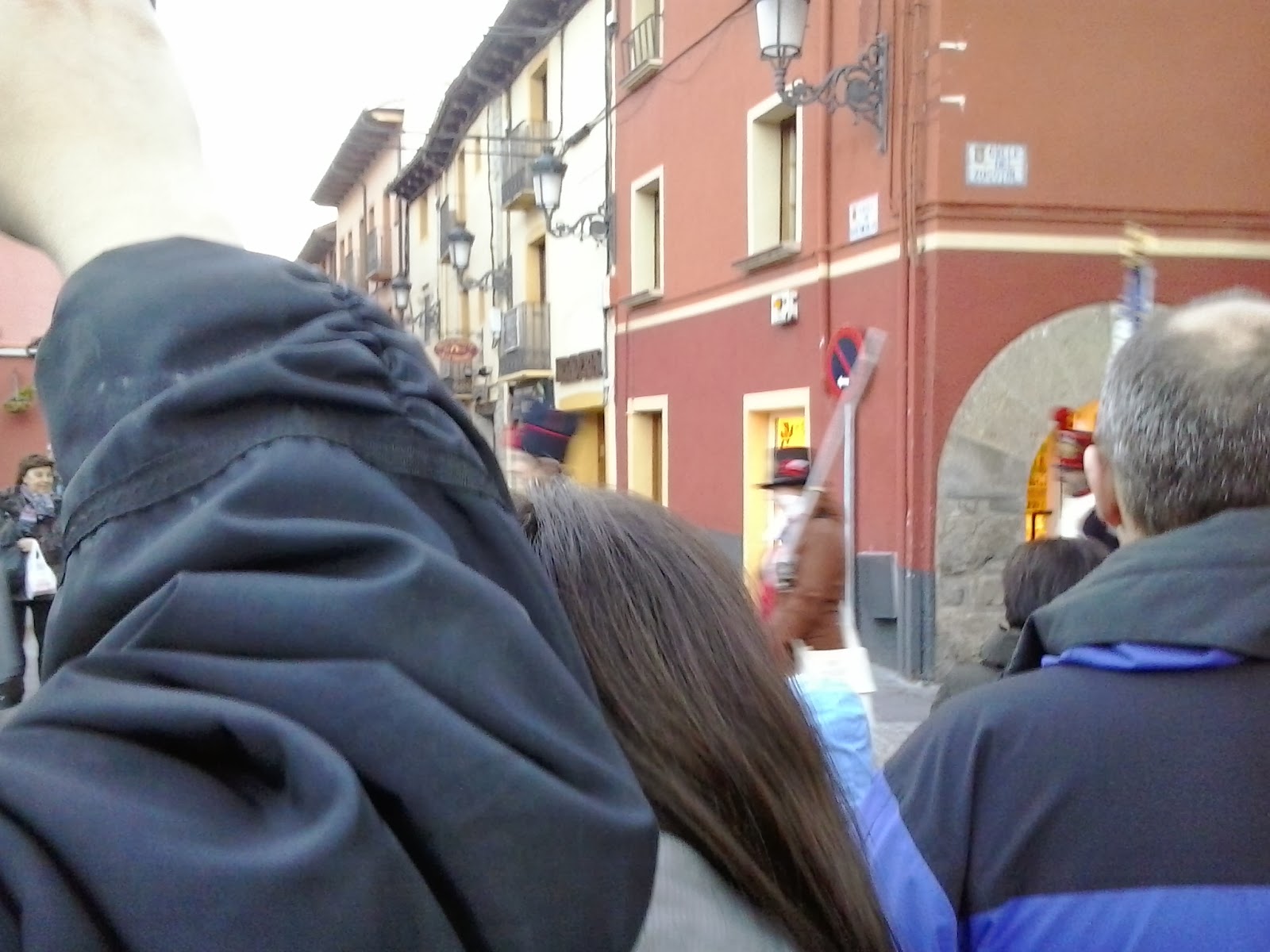
Some time after six, the troops marched out of the fort and into the city centre. There were apparently going to be skirmishes in the old quarter.
If I'd known in advance this was going to happen, I would have brought my camera home; it's in Zaragoza, waiting to take decent photos of the statue of General Palafox.


This bad photo is here because it's the only person I thought I recognised. I'm waiting for confirmation if it really was her!


Saturday, 18 January 2014

Fuente de los incrédulos

Ramón de Pignatelli was an "enlightened" man. He was prime minister in the 18th century. The works for the irrigation system were started in 1738, but didn't go very fast until Pignatelli was in charge. They got as far as Zaragoza in 1786, commemorated by the "unbelievers' fountain"; nothing to do with religion  but to celebrate a work of engineering delayed for a couple of centuries and which some people believed would never bring the water to Zaragoza. 
Wikipedia says:  "When Ramón Pignatelli started to build a canal from the Cantabrian sea to the Mediterranean, many people laughed at the idea. When the waters reached Zaragoza, he ordered a fountain to be built to celebrate it, as the inscription says: "to convince the incredulous and to relieve passers-by" ("Incredulorum convictioni et viatorum commodo" Anno MDCCLXXXVI) Thus the fountain was proof of the success of the enterprise and a joke directed towards those who had not believed it was possible."

Saturday, 11 January 2014

Sleeping woman

In the centre of Zaragoza, surrounded by traffic, a woman lies sleeping. She rests her head on ears of wheat. 


La siesta, by Enrique Galcera, 1963 in the Plaza del Paraíso. I love this sculpture. 
I found the information in a blog called Lo que veo en Zaragoza: http://loqueveoenzaragoza.blogspot.com.es/p/estatuas.html