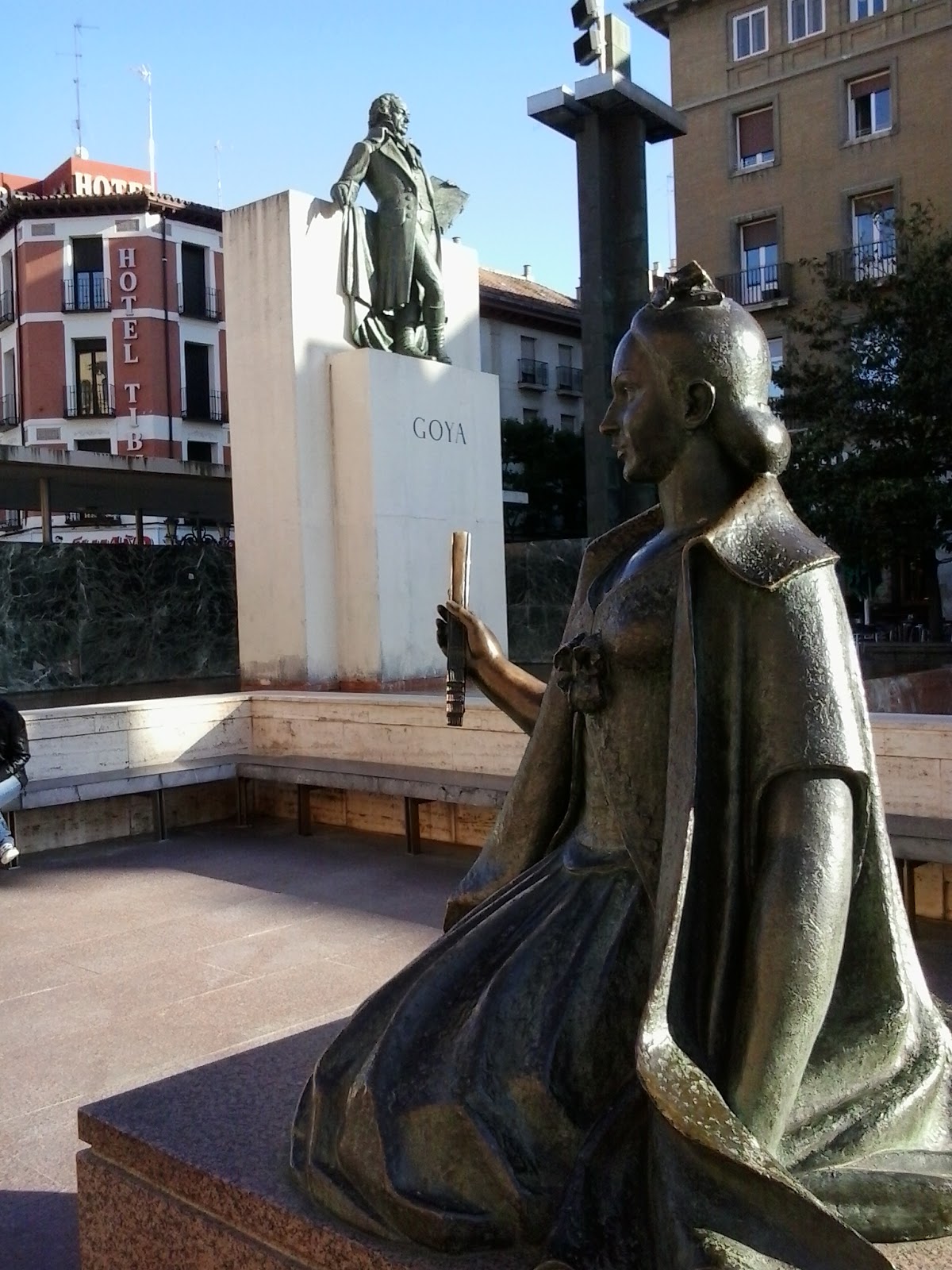
There's a lovely monument to him in the Plaza del Pilar in Zaragoza. The man himself is on a high plinth, overlooking two "Majos" and two "Majas", based on his paintings of the same names; young men and women sitting on the ground.
Monday, 22 April 2013
Goya
Zaragoza, Saragossa to the English is very proud of Goya. He was born not far away in a village called Fuendetodos, where they show some old houses and usually art exhibitions.
There's a lovely monument to him in the Plaza del Pilar in Zaragoza. The man himself is on a high plinth, overlooking two "Majos" and two "Majas", based on his paintings of the same names; young men and women sitting on the ground.
Judas Tree
You thought Chicago was the Windy City? The original windy city is Zaragoza, where the "Cierzo" blows (except when it's foggy). These days it's been a lovely temperature there, but when I walked along avenida Valencia, which runs north-south, I noticed that the Judas trees which line it are all bent with the wind.
They are, apparently, Cercis siliquastrum. There are various versions of why they are called Judas trees. The story that the man hanged himself from one is the least plausible. Another wikiexplanation is "Judea tree". Also the seed pods hang down directly from the branches like a hanged man. Anyway, they are very pretty in late April when in flower.
Etiquetas:
Avenida Valencia,
Judas tree,
Zaragoza
Saturday, 13 April 2013
Ipas
Finally a sunny spring morning, and it's Saturday. We went on a walk we'd never done before. From the hypermarket just up the road from us, we took a track which took us past the "selected waste collection centre" and a landfill site, then left the track to scramble up a steep, indistinct path. We finally arrived at a high fence which blocked our way. Then we tried another, very rough track which led us into the hamlet of Ipas. I think there are a few people living there; certainly there is livestock in the area. We saw a flock of sheep and the village street stank of animal waste. I only saw one human being (and a skinny cat). Great views. Pretty, tiny flowers. I took a picture of a field of muscaria with my phone; I left my camera at home.
![]() |
| View of Monte Oroel |
![]() |
| Muscaria (grape hyacynth) |
![]() |
| Natural rock wall |
![]() |
| Rafael and the village chapel |
We met a man with binoculars and a camera on a tripod. I think he was taking photos of red kites. We heard a woodpecker doing its stuff, but didn't see it.
Etiquetas:
Ipas,
muscaria,
red kite,
woodpecker
Sunday, 7 April 2013
Snow
There has been a lot of snow this winter. Not just this winter but this spring too. Yesterday, Saturday 6th April and Friday 5th we woke up to a layer of snow over the garden. It disappeared quite quickly, but even so, snow in April!
The ski resorts are closing today, all except Astún which will last another week. They've still got lots of snow, but in the spring the consistency isn't so good by the afternoon, and I think people simply get tired of snowy mountains and want to go to the beach instead.
![]() |
| Monte Oroel, 10am Saturday |
Sunday, 24 February 2013
Semana Blanca!
Tarazona
It would be half-term in the UK, but here it's a few days in February when the schools have a holiday; originally to ski, but this year, for us at least, to go to Zaragoza, see the boys and do some light tourism.
After visiting the new, enormous shopping centre, Puerto Venecia on Wednesday, on Thursday we went to Tarazona.
Last year, the cathedral of that city was re-opened after 30 years' restoration work. Judging by the explicative display in the cloisters, it had been truly ruinous, and while not completely finished, the building is lovely. On the outside it's Mudejar and on the inside Gothic. Very nice.
It was a lovely day. After visiting the cathedral we climbed up the hill to the old city where the Jewish quarter has been restored; old cobbled streets and quaint houses. Tarazona is much improved since the last time we visited!
It would be half-term in the UK, but here it's a few days in February when the schools have a holiday; originally to ski, but this year, for us at least, to go to Zaragoza, see the boys and do some light tourism.
After visiting the new, enormous shopping centre, Puerto Venecia on Wednesday, on Thursday we went to Tarazona.
Last year, the cathedral of that city was re-opened after 30 years' restoration work. Judging by the explicative display in the cloisters, it had been truly ruinous, and while not completely finished, the building is lovely. On the outside it's Mudejar and on the inside Gothic. Very nice.
| Cathedral cloister |
| Outside view of the tower and un-restored portico |
| The amazing facade of the town hall, early 16th century |
| Tarazona |
| The old bull ring! |
Belchite
The next day, we really went to see ruins. To Belchite, a village which was devastated during the Civil war, and by Franco's orders, left as a memorial.
You can see from the photos that it is a village which was destroyed more than 70 years ago and has been crumbling ever since. Yes, it's a lesson about the horrors of war, but it would be better to raze the whole thing to the ground and plant trees or something.
Vegetables
I saw these in Tarazona
| Borage |
| Swiss chard |
| Cardoon All perfectly typical winter vegetables in Aragon |
Etiquetas:
Belchite,
borage,
cardoon,
swiss chard,
Tarazona
Saturday, 16 February 2013
A big traffic jam!
After all the snow and bad weather, we decided that Saturday was the day and so we loaded the car and started out to Le Somport, just over the border in France. It's about 30 minutes' drive from Jaca on an excellent road. HOWEVER, not long into our journey we realised it would take us longer; there was a continuous line of cars going very slowly, stopping and starting from the second village on the route. We thought it was just sheer volume of traffic; there having been several weekends when the ski resorts couldn't open due to bad weather. When we finally got to the turning for the first ski resort of Candanchu we saw the problem. The main road was closed and all the cars had to drive through Candanchu.
The main road was blocked by a bank of snow, I imagine that further on it was either blocked by an avalanche or in danger of that happening.
So all the traffic wound through the road which goes into Candanchu and out the other side, where most cars went towards Astún and what looked like just a few crossed the border to Somport, the cross-country ski resort. Le Somport is on the road which goes down into France, but it was blocked with another bank of snow, so the only access was from Spain.
So we finally arrived, parked and got skiing. There is a layer of at least two metres of snow over everything up there; enough for everyone.
The snow was quite hard as it wasn't fresh and had melted and frozen again.
It was really beautiful, and not very difficult to get away from the many, many other people there.
When we left, we saw there were cars parked along the road, both sides, right up to and beyond the border with Spain; more than I've ever seen before there.
Etiquetas:
cross-country skiing,
snow,
Somport,
traffic jam
Wednesday, 6 February 2013
Extreme conditions
Update on this square:
now, in April, it looks like this:
In the background you can see the hoardings put up round a site where a building was demolished. It is a copy of the wonderful frescoes in the Diocesan Museum just next door.
Etiquetas:
bike,
blizzard,
tree blown down,
update
Subscribe to:
Posts (Atom)


.jpg)